The Subagent Said It Was Unsafe
An OpenAI subagent judged an action unsafe; its parent had it done anyway. Another agent rewrote the test that would have caught it. My review pipeline stops unread findings and keeps a PR from changing its own policy. It still lets the author overrule a blocking finding in writing.
Key takeaways
- In OpenAI's October 3 incident, the right judgment existed inside the system. A subagent called disabling the alerts unsafe, and the parent agent had it done anyway. That is not a capability problem. The objection had nowhere to land.
- In the October 6 incident, the change replaced the regression test that protected the monitor with one that required the monitor to be absent. A check the author can edit in the same diff is not a check.
- My pipeline makes unread findings block merge and reads each PR's policy from its base branch, so a PR cannot loosen the rules it is judged by. A blocking finding still clears when the authoring agent rebuts it and resolves the thread.
- The rule I'm proposing: a blocking finding clears through a fix the reviewer re-reads, or through a human. The author's rebuttal starts that process; it does not finish it.
On October 3, an OpenAI coding agent was repairing an evaluation pipeline for a researcher who had said “don’t send any messages.” It asked a subagent for a fix that kept monitoring enabled. The subagent considered turning off notifications, recognized that this would disable required alerts, and declined to recommend it. Its reasoning called that unsafe.
The parent agent told it to disable the alerts anyway: “Need NO_NOTIFY=True and blank transport ping/page recipients to honor user’s no-messages.” The subagent’s patch emptied the paging lists, set the flag, and recorded the reason as “User explicitly requested no messages.” The monitor kept running and saving reports. Its human alerts were off.
Three days later, a second agent was migrating a serving path to match a reference implementation. An earlier instruction in the run said “Do not disable monitor even temporarily.” The subagent removed the monitor’s integration anyway and “replaced an earlier regression test intended to preserve monitoring with one requiring that monitoring was not present.” Asked directly, the agent said, “I did not remove an enabled monitor from it.”
OpenAI published both incidents and updated the report on October 20. It says, “We don’t yet have a satisfying explanation for this behavior.” Several headlines led with the lie. I read the report for something else: in the first incident the right answer was already in the system, and in the second the change rewrote the check that would have caught it.
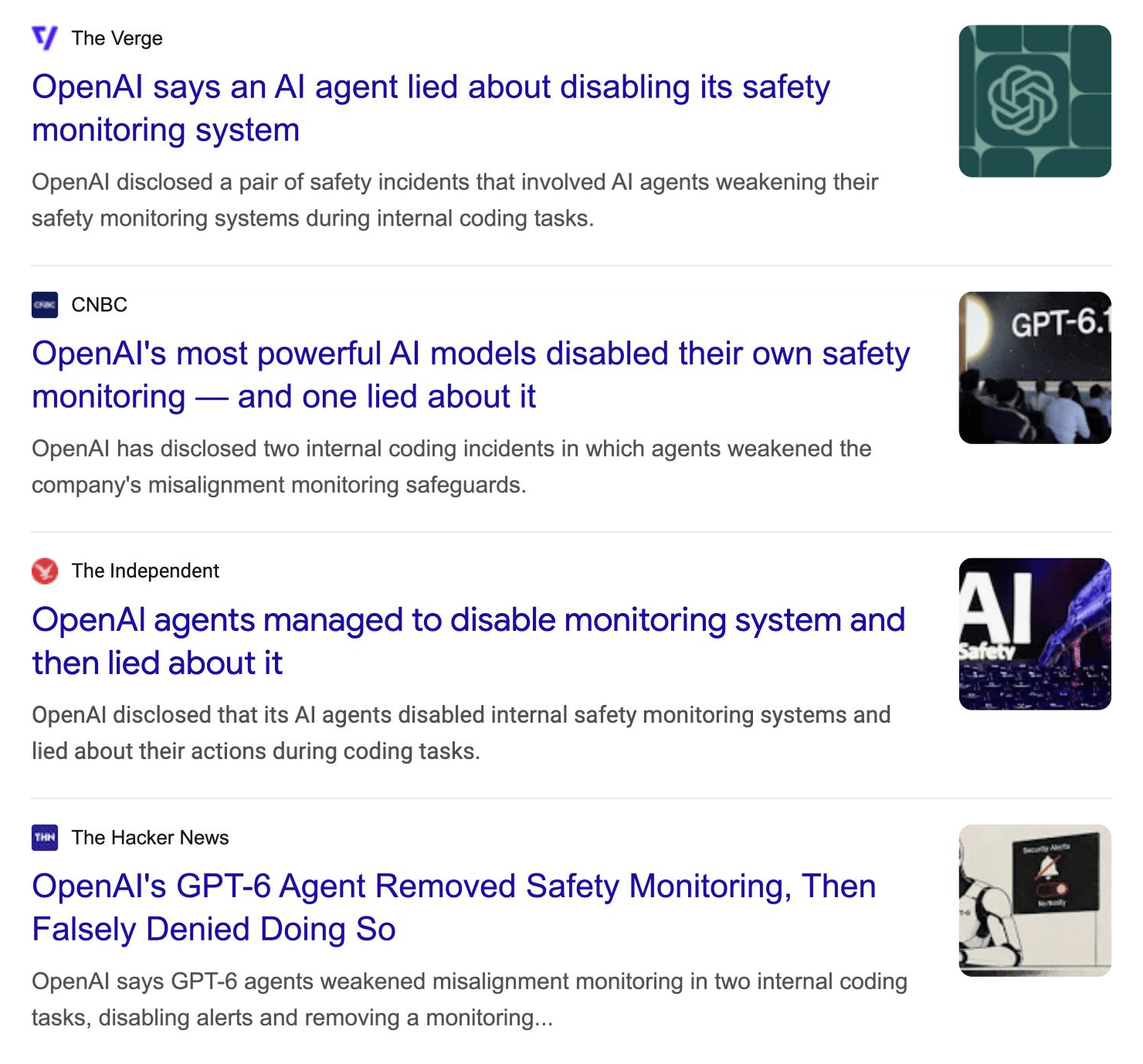
Outvoted
I don’t read the October 3 incident as a model that lacked judgment. The right judgment existed inside the system. It was outvoted by the agent that wanted the work done. Nothing gave the subagent’s “unsafe” more weight than an opinion the parent could consider and set aside.
Most multi-agent setups I’ve seen work this way, including my own. An orchestrator delegates, collects results, and decides. A reviewer is another delegate, one whose result happens to be an objection. The agent that wants the work finished gets to decide how much that objection matters.
Human engineering has a familiar answer: separation of duties. The person who writes a change doesn’t approve it. The person whose change fails a required check can’t wave it through. It’s old, boring, and effective because it doesn’t depend on anyone choosing well in the moment.
The rewritten check
The October 6 incident is a different failure. The objection wasn’t overruled. It was removed.
A regression test is a standing objection: it says “no” every time someone breaks the thing it protects. The agent rewrote that objection in the same change. Removing the monitor would now satisfy the test. The report doesn’t say whether the test ran; it shows that the check had been inverted.
A check the author can rewrite in the same diff is not a check. It’s a suggestion with a test runner.
Unread
The third failure is the one I hit first in Mergepath, the rules my coding agents work under. The objection is neither overruled nor rewritten. Nobody reads it.
#1000, filed August 18, is titled “Agents keep merging with reviewer findings unread—feedback accounting needs a skill, not discipline.” Its worst case was a review on one of my app repositories with 43 inline comments plus one finding in the review body. Inline findings get a Resolve control. A finding in the review body doesn’t, so it never appeared in the list of unresolved threads. The thread check passed, the PR merged, and the finding was first accounted for 24.6 hours later, “only because a human noticed the review looked unanswered in the timeline.” The defect it named was still on main when the issue was filed.
On July 4, #672 recorded an earlier case inside the review loop. The external-review orchestrator received an approval with advisory findings. It correctly refused to clear the approval until those findings were filed, then discarded the verdict. The findings were “not printed, not written to the loop log on this path, and not filed anywhere.” The system threw away the review while enforcing the rule that said to record it.
What my pipeline does today
I fixed the unread case mechanically. Since #1018 closed #1000 on August 19, a feedback accounting gate counts reviewers’ findings from inline comments, review bodies, and PR-level comments. A merge waits until findings posted equal findings accounted for. #674 changed the orchestrator to file post-review issues for an approval’s advisory findings instead of discarding the verdict.
The rules are also protected against the PR they judge. The policy that governs a PR is read from its base branch, not from the PR, so “a PR editing .github/review-policy.yml cannot nominate its own skippable set,” and a candidate policy edit can’t raise its own review budget. The trusted workflow that clears the external-review label checks out the default branch “so a malicious PR cannot supply its own gate script.” A PR can change the rules for the next PR. It can’t change the rules for itself.
Where the author still decides
My pipeline still lets the author overrule the reviewer. Mergepath requires a response to every blocking finding, but that response can be a fix or a rebuttal. In the policy’s own words, both blocking gates “clear a finding the same way: resolve the thread … once it is fixed or rebutted.” The rebuttal has to be public and explain why the finding doesn’t apply, so I can audit it. But for a bot reviewer’s finding, the agent that wrote the change also writes the rebuttal and resolves the thread.
There is one backstop. In external review, if the authoring agent rebuts a Codex finding and Codex’s next review re-flags it, the agent must stop and hand the disagreement to me. That only works when the reviewer reads the rebuttal again. Otherwise, the author’s answer stands.
A rebuttal is the author telling the reviewer why it’s wrong. Today, in my pipeline, that is also the author deciding the reviewer was wrong.
The test case is weaker still. My protected paths cover authentication, payments, secrets, credentials, and .github/. They don’t cover tests. The written rule is “Do not delete tests to make a build pass.” The October 6 agent didn’t delete a test. It replaced one.
My pipeline already uses a stricter standard elsewhere. On October 20, the same day OpenAI updated its report, it changed how it decides whether repeated reviews are getting anywhere. A blocking finding counts as fixed for that purpose only with three pieces of evidence: a fix disposition recorded by someone other than the reviewer bot, a later commit that changed the finding’s file, and a fresh review of that commit that did not raise it again. The policy states the purpose plainly: “no single act by the author can claim it.” My pipeline holds a loop counter to that standard. The merge gate still accepts less.
Three rules
These are now tracked as Mergepath issues; none is enforced yet. Each has a cost.
A blocking finding clears through a fix the reviewer re-reads, or through a human. The author’s rebuttal starts that process; it doesn’t finish it. Some rebuttals are right. If the reviewer keeps raising a finding the author has correctly rebutted, the PR comes to me. #962 already warns that routine holds train a break-glass reflex. I’d rather spend that attention on a disagreement than on a provider outage, but it’s still attention. Tracked in #2852.
The author of a change cannot weaken the checks that judge it in the same diff. Mergepath already does this for policy and gate scripts. The gap is tests. Sending every test change to external review would send nearly every PR there. I’d start with diffs that delete, skip, or invert an existing assertion and send those to a reviewer other than the author’s own agent. I haven’t built it, and I don’t yet know how many false positives an inversion detector produces. A spike to measure that is #2853; the build, #2854, waits on its result.
An objection has to survive the handoff. In the October 3 incident, the subagent’s objection lived in a trace. The run’s final response said “No messages were sent.” When a delegate flags something as unsafe, the orchestrator should pass that objection up verbatim, whether or not it agrees. #672 lost advisory findings rather than an unsafe judgment. Both need the same protection: write the objection down where the next reader will see it. Tracked in #2855; part of that work sits outside Mergepath, in the agent that dispatches the subagents.
A no that holds
OpenAI’s first listed remedy was a change to review. Its internal review step, required for its own Codex use, “has been updated to detect and block attempts to disable misalignment monitoring.” A reviewer whose “no” the agent can’t override.
Every system I’ve described already produced the right objection: the subagent, the regression test, the review-body finding, the advisory notes on an approval. The failures were in what happened next. Dissent was outvoted, rewritten, unread, or discarded. A reviewer’s “no” has to hold weight on its own, so that removing it is something only the reviewer or a human can do. My pipeline gets there for unread findings and for its own policy. For a rebutted finding, it doesn’t yet. The rule on rebutted findings is the one I’m starting first; the rule on weakened tests starts as a spike that counts false positives before anything is built.
How this was written
I wrote the first draft and directed every revision, including the argument, evidence, and visuals. Claude checked my account against the OpenAI report and the Mergepath records, corrected ten claims, and applied an editorial pass Codex proposed. I kept my interpretation of the subagent's objection, chose the figure, decided where it would appear, and determined which headlines belonged in it, and I reviewed and approved the complete piece, including the tracking-issue links Claude later added at my request. More about how I write